Validating a market opportunity as a member of an early-stage founding team
Role: Founding Growth Contributor
Timeline: April 2026 – August 2026
The Challenge
How do you build the right product before writing the first line of code?
Many organizations rely on workflows that require employees to gather information from multiple sources before completing a task. When information is fragmented, teams create spreadsheets, documents, bookmarks, and workarounds to get work done.
Our team believed this problem existed within a healthcare administrative workflow, but before investing heavily in product development, we needed evidence rather than assumptions.
01. Is the problem significant enough to solve?
Does this issue create meaningful friction, consume valuable time, and impact day-to-day operations?
02. Who experiences the greatest friction?
Which users encounter the problem most frequently and feel its effects most acutely?
03. Who would ultimately pay for a solution?
Who has both the motivation and authority to invest in solving the problem?
Questions We Needed to Answer
My Role
As a member of Praxigen's founding team, I lead customer discovery and market validation efforts to better understand operational challenges faced by healthcare organizations. Through stakeholder interviews, workflow analysis, and hypothesis testing, I help translate customer insights into product and go-to-market recommendations that inform company strategy.
Conducting customer discovery interviews
Building outreach pipelines
Developing customer personas
Identifying recurring pain points
My Responsibilities Include:
Testing market and product hypotheses
Supporting go-to-market strategy
Engaging prospective pilot partners
Research Execution
To better understand customer needs, I conducted structured interviews with healthcare administrators, operational leaders, consultants, and front-line staff. These conversations focused on understanding existing workflows, identifying inefficiencies, and validating assumptions about potential solutions.
700+
Outreach Attempts
50+
Discovery Interviews
26
Pain Points Identified
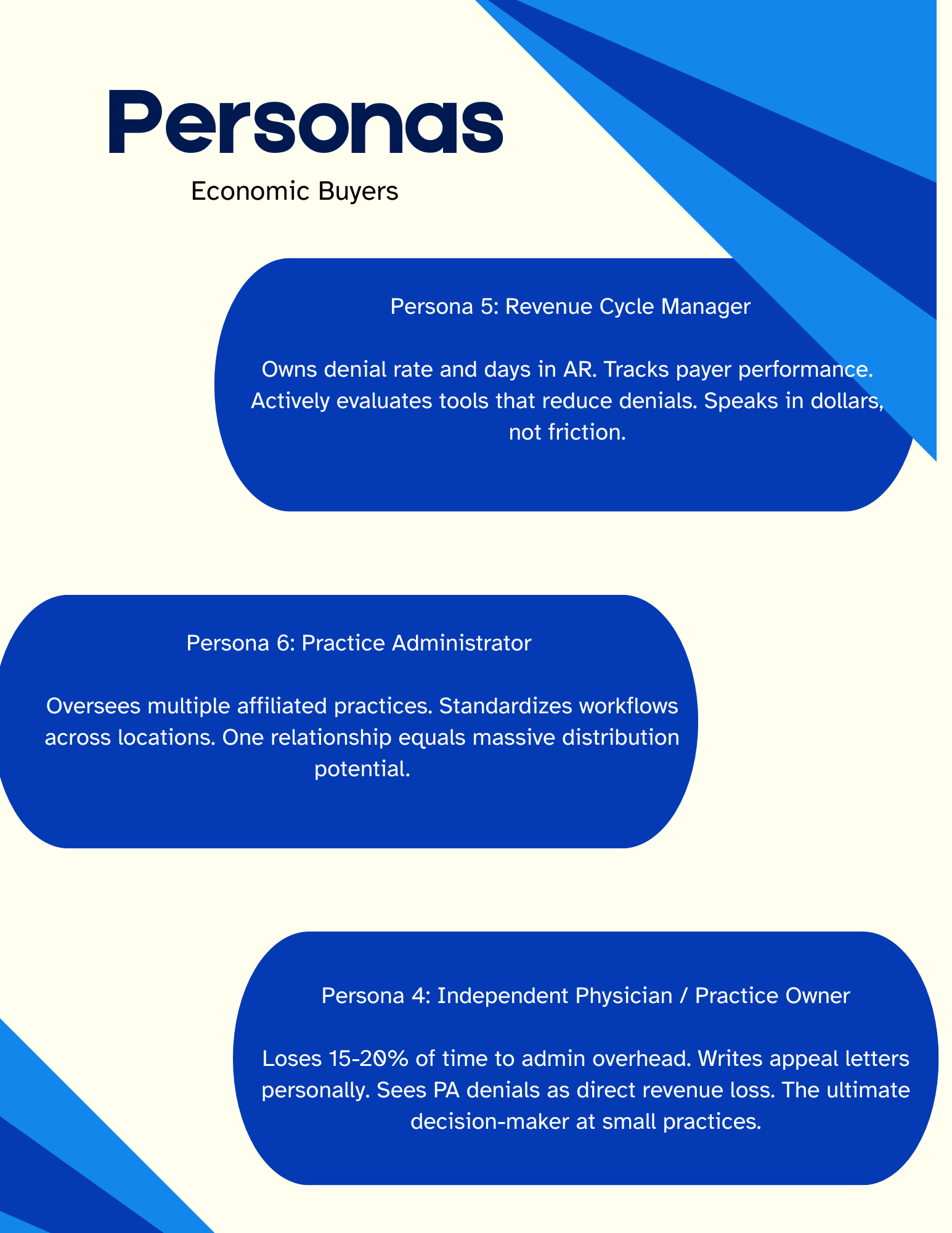
One of the most important findings was that the people experiencing the problem daily were often different from the people responsible for purchasing software.
Understanding the Customer
Not every user is a buyer
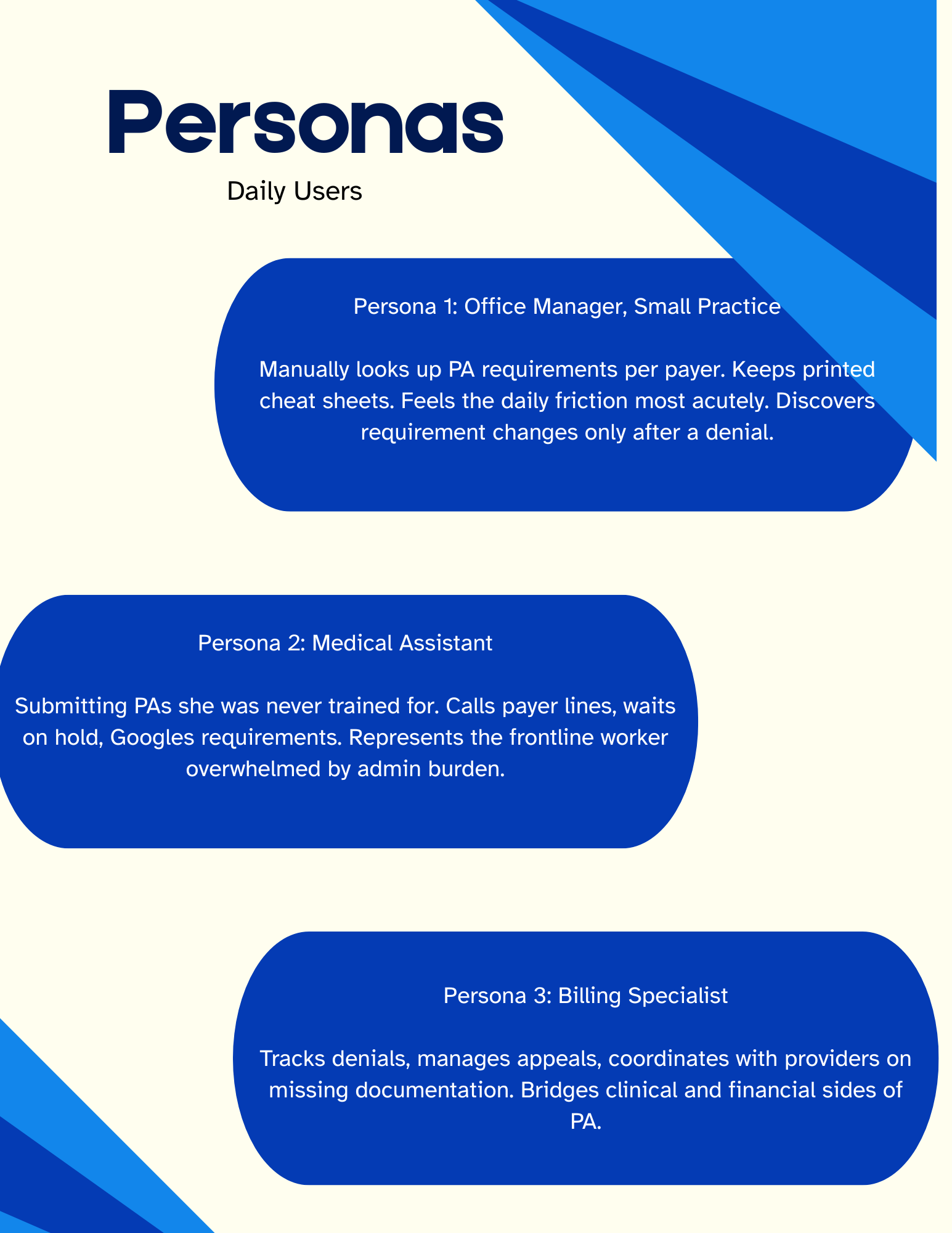
This distinction became a critical consideration for both product positioning and go-to-market strategy
Key Insights
What the research revealed
Fragmented Information
Users frequently relied on multiple systems, documents, and portals to complete a single workflow.
Informal Workarounds
Many teams created their own spreadsheets, bookmarks, and tracking systems to compensate for inefficient processes.
User ≠ Buyer
The people most affected by workflow inefficiencies were not always the people making purchasing decisions.
Distribution Opportunities
Consultants and organizations serving multiple practices emerged as potential channels for broader adoption.
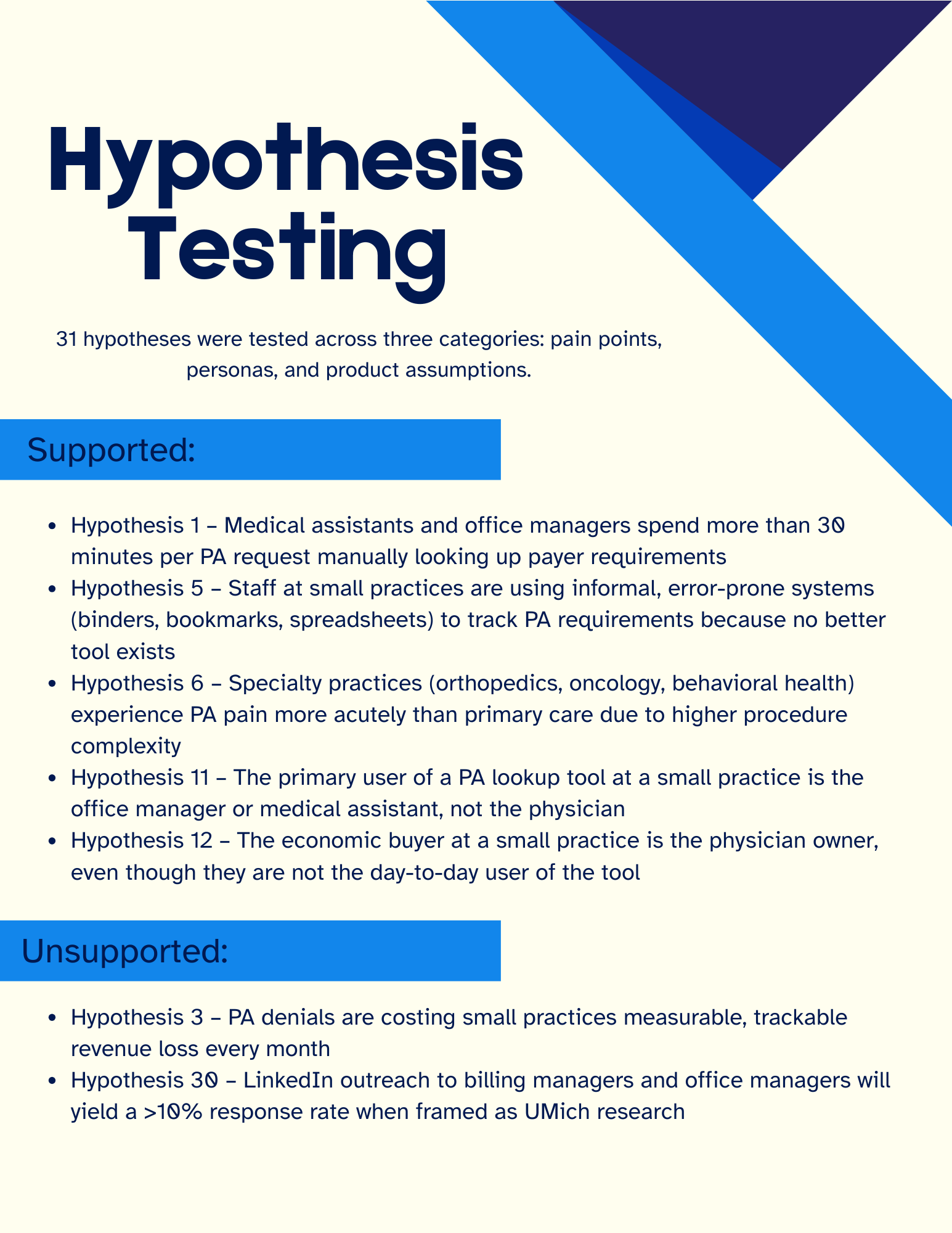
Hypotheses
Rather than relying on intuition, I worked to validate assumptions through direct customer feedback.
Challenging assumptions with evidence
Impacts
How the research influenced strategy
Product Impact
Refined customer personas
Identified priority pain points
Clarified workflow requirements
Informed product direction
Business Impact
Improved positioning and messaging
Identified economic buyers
Supported pilot acquisition efforts
Uncovered potential distribution channels
Reflection
Working on an early-stage founding team has taught me that successful products are built through continuous learning rather than assumptions.
This experience has strengthened my ability to conduct research, synthesize qualitative insights, and translate customer feedback into strategic recommendations. Most importantly, it has shown me how product strategy, customer discovery, and go-to-market execution work together to bring a new product to market.